
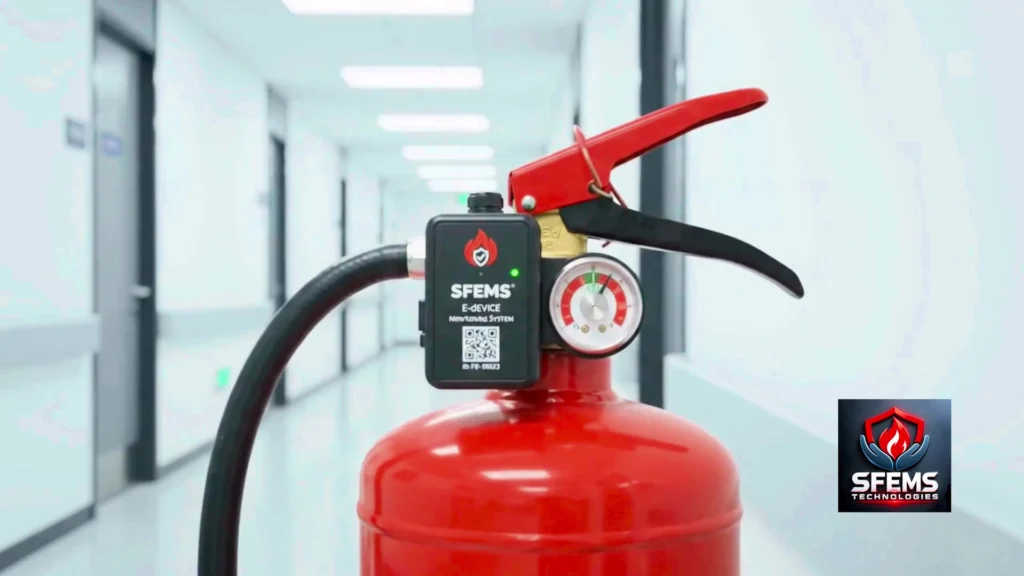
Every facility manager knows the routine. Once a month someone takes a clipboard or a tablet, walks every floor, looks at every extinguisher and signs the tag. It is reliable, it is required, and in a big building it eats a surprising number of hours.
Smart fire extinguisher monitoring promises to change that. But what actually changes, and what does not? Here is a straight comparison.
When you find out about a problem
Manual: at the next round. If an extinguisher loses pressure on day two of a 30-day cycle, it sits that way for four weeks.
Smart: when it happens. A device on the extinguisher reports the change, and an alert reaches your team on web and mobile. This is the biggest difference, and everything else follows from it.
Where your team’s time goes
Manual: most of the round is spent confirming that working extinguishers still work. The few that need attention are found by checking all of them.
Smart: you start with a short list of the units that have reported a change. The walk-round still happens, because some things need a person, but it is focused and quicker.
The quality of your records
Manual: records are as good as the person filling them in, and paper tags are hard to search across a whole portfolio.
Smart: device status and alerts are recorded automatically with a time and a location. When someone asks what happened to the extinguisher on level 3 last March, the answer is already there.
Managing more than one site
Manual: each site reports separately, often in a different format, and comparing them takes effort.
Smart: a platform such as SFEMS CLOUD shows every site in one view, so you can see which locations are fully ready and which need a visit.
What does not change
It is worth being clear about this. Connected monitoring does not replace:
- the inspections required by Civil Defense, the Saudi Building Code or the standards your contractor works to;
- the annual service by a qualified technician;
- periodic hydrostatic testing and recharging;
- visual checks for blocked access, unreadable labels or physical damage;
- your emergency procedures and staff training.
What it does is give the people responsible for all of that better information between visits.
When smart monitoring is worth it
It pays off most when one or more of these is true:
- You have many extinguishers, often hundreds, across large or complex buildings.
- Some units are hard to reach: rooftops, plant rooms, remote yards or outdoor sites.
- Extinguishers are often moved or tampered with, as in warehouses, schools or busy public areas.
- You manage several sites and want one picture of all of them.
- You need a reliable record for audits, insurers or clients.
For a small office with a handful of extinguishers on one floor, a well-kept monthly round may be all you need. That is an honest answer, and we would rather say it than oversell.
How the SFEMS system fits together
A SFEMS MINI (E-device) on each extinguisher reports pressure, temperature, tamper and movement. SFEMS REPEATER extends the LoRaWAN signal where the building needs it. SFEMS LINK connects the site to the cloud over Ethernet, Wi-Fi or 4G, and SFEMS CLOUD turns it all into status, alerts and reports your team can act on.
Thinking about it for your building?
Get in touch with a rough idea of your site and extinguisher count. We will tell you honestly whether connected monitoring makes sense for you, and show you how it works.