
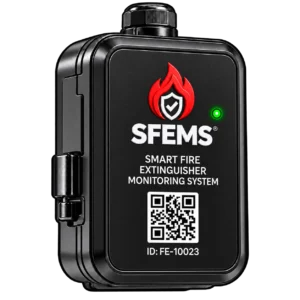
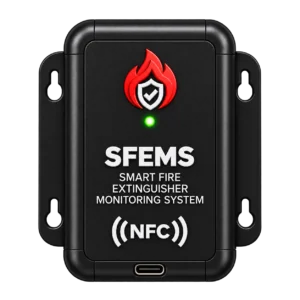
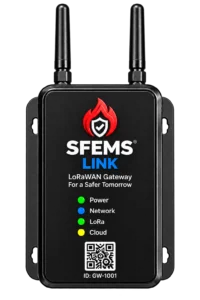
Real-Time Monitoring
Track device status and relevant safety signals across sites.
Integrated smart fire-safety solutions combining real-time monitoring, instant alerts, cloud visibility and scalable multi-site management.
ONE SIGNAL. A CONNECTED JOURNEY.
From the extinguisher to the network. From cloud intelligence to the people responsible for safety.
 SFEMS
Pressure, temperature, movement and tamper signals at the source.
Additional coverage where the facility layout calls for a repeater.
Device information moves from the site toward the cloud platform.
Device condition and site information come together in one view.
Review the condition, affected device and location in context.
Authorized users review their sites and plan inspection or maintenance.
Illustrative information flow, not live telemetry. Alerts and access depend on site configuration and user permissions. Monitoring supports inspection and maintenance.
Most facilities still learn about extinguisher problems the slow way. Someone walks the building, opens cabinets, checks gauges and writes it down. It works, but only on the day of the round. A cylinder that loses pressure the week after, or gets moved to prop open a door, stays that way until the next visit.
With SFEMS, every extinguisher is reporting all the time. Your team starts the day with a list of the few that actually need attention, instead of a full building to walk. Inspection rounds still happen, but they are shorter and better targeted, and nothing waits a month to be noticed.
Facility managers rarely look after one building. SFEMS CLOUD puts every site you manage into one view, so you can see at a glance which locations are fully ready and which need a visit. Recorded activity builds up over time, which helps when you plan maintenance budgets or need to show what was done and when.
It starts with a conversation about your site: the layout, how many extinguishers you have, what connectivity is available and who should receive alerts. From there we plan coverage, which decides whether repeaters are needed and where SFEMS LINK should sit. Devices are then fitted, the system is checked end to end, and your team is shown how to use the dashboard before handover.
Track device status and relevant safety signals across sites.
Surface events that require attention within operational workflows.
View sites, status and alerts from a central interface.
Support indoor, outdoor and remote-site scenarios with the approved architecture.
Bring device and site status into a clear operational view.
Turn important events into clear notifications for teams.
A flexible structure that can grow with sites and devices.
Focused monitoring for a defined set of devices in one facility.
Consolidated status and alerts across multiple locations.
Scalable structure for centralized management and integration requirements.
Answers for this page, with links to relevant detail.
Supported condition information travels from SFEMS eDevice through the compatible site network toward LINK. CLOUD processes received information and makes configured status and events available to authorised users.
Review extinguisher compatibility, mounting, building obstructions, wireless coverage, gateway connectivity and the people responsible for follow-up. The industry applications help frame the operational environment.
Compatible devices send supported events through the communication path. SFEMS CLOUD evaluates configured alert conditions and presents information to authorised personnel. Event types and notification arrangements should be agreed for the project.
Expansion can be planned around compatible equipment, network capacity and the platform configuration. Each new facility needs its own review of coverage and connectivity. Explore the LINK gateway requirements.
Status and event information can help teams identify the asset to review and organise follow-up. It complements inspection and servicing. The inspection checklist guide provides additional context for facility teams.
Contact us to discuss your use case, scope and suitable solution options.